What is hort?
hort is a self-hosted artifact repository for consuming, storing, and publishing software artifacts. It provides repository workflows across OCI/Docker, npm, PyPI, Cargo, and Maven/Gradle; operations supported by a particular client or format can differ.
What operators manage
- Repositories and upstreams: local publishing and pull-through access to external package registries.
- Artifact handling: content-addressed storage, upstream verification, scanning, quarantine, and policy-controlled availability.
- Identity and authorization: OIDC authentication, service accounts, workload federation, and explicit grants.
- Configuration: file-based YAML desired state loaded from
HORT_CONFIG_DIRand applied when the server starts.
Components
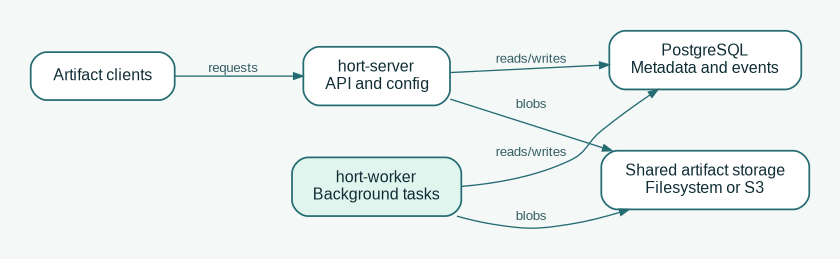
| Component | Operator responsibility |
|---|---|
hort-server | Serves repository and administration APIs, validates/applies configuration at startup. |
hort-worker | Runs scanning and background tasks separately; provision its CPU and memory independently. The worker image includes external scanner binaries. |
hort-cli | Operator-facing command-line tool for administration and automation. |
| PostgreSQL | Database to provision separately; the Helm chart does not install PostgreSQL. |
| Artifact storage | Filesystem/PVC for a single-replica deployment or an S3-compatible backend for multi-replica deployments. |
Recommended first steps
- Use Quickstart to establish a running service and reach its health endpoints.
- Choose native Linux executables or Kubernetes with Helm based on your infrastructure.
- Follow Declarative configuration to validate and apply a repository definition.
- Follow a format-specific guide such as OCI pull-through to test a package client. The pull procedure still needs real-cluster acceptance.
Important: A proxy repository is not equivalent to bypassing upstream rate limits. New artifacts may be quarantined and unavailable until scanning/release policy permits access.
Monitoring and AI-assisted operations
hort-server validate-config can check the declarative configuration offline before a rollout. Server and worker telemetry can help operators investigate failures and capacity. These are useful inputs to AI-assisted operational workflows, not a claim that hort contains an autonomous AI agent. Access to metrics is protected by authorization: the server's metrics listener requires read_metrics permission.